
Introduction
Self-directed IRAs (SDIRAs) are increasingly popular among real estate investors seeking tax-advantaged exposure to real estate syndications. When structured correctly, they can be powerful. When structured incorrectly, they can wipe out the IRA’s tax benefits and create unexpected tax filings and penalties.
This article explains what can go wrong with SDIRA syndication investing, the compliance rules that matter most, and how sponsors and investors can reduce risk.
Quick answer
When a self-directed IRA invests in a real estate syndication, the IRA, not the individual, must own the interest, receive income, and pay expenses. Common failures include prohibited transactions (personal use, side benefits, or guarantees) and unexpected UBTI (Unrelated Business Taxable Income) from leverage known as UDFI (Unrelated Debt-Financed Income). Staying compliant requires strict separation, clean documentation, and proactive planning before closing.
The starting point: the IRA is the investor
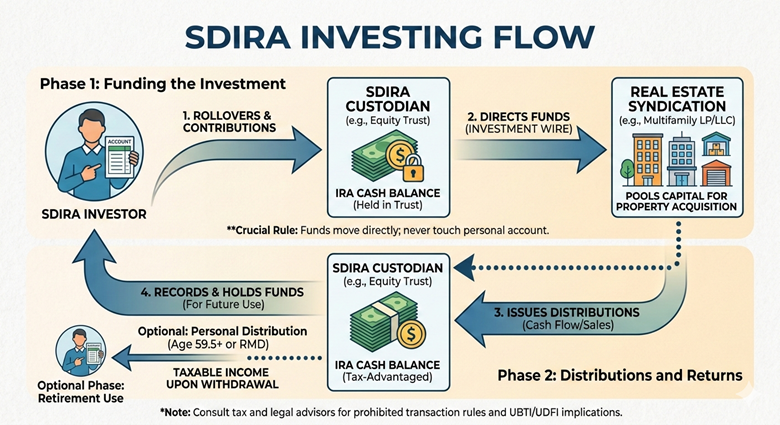
The most important rule is also the simplest: When a self-directed IRA invests in a syndication, the IRA is the investor—not the account holder.
That distinction drives almost every compliance requirement. The IRA:
-
Owns the syndication interest
-
Receives the income/distributions
-
Pays related expenses (from IRA funds)
-
Bears the tax consequences (including potential UDFI)
The account holder generally cannot personally benefit from, control, or “interact with” the investment outside narrow IRS boundaries.
What 3 syndication operators need to know about self-directed IRA investors
From the sponsor/operator perspective, SDIRA capital can be attractive, but it introduces extra documentation, reporting, and compliance risk.
1) Confirm the operating agreement allows retirement accounts
Some operating agreements prohibit IRA/retirement accounts due to administrative burden or concerns around tax reporting. If you accept SDIRA investors, ensure the documents clearly address:
-
Eligible investor types (including IRAs)
-
Subscription process through custodians
-
Capital calls (if applicable) and how custodians handle them
-
Distribution mechanics (paid to the IRA, not the individual)
2) Avoid “investor perks” that create prohibited transactions
Many sponsor-friendly touches become landmines with SDIRAs. If the syndication owns a resort, short-term rental, golf property, or similar asset, do not offer SDIRA investors:
-
Discounts
-
Free stays
-
Preferred booking/access
-
“Friends and family” benefits
-
Any personal use (directly or indirectly)
Why it matters: The IRA owner is typically a disqualified person, and personal benefit can trigger a prohibited transaction.
A single prohibited transaction can cause the entire IRA to lose its tax-advantaged status effective January 1 of that year.
3) Track leverage-related income for potential UDFI exposure
If the deal uses leverage, sponsors should be prepared to identify and report income that may be treated as debt-financed income, which can trigger unrelated business taxable income (UDFI) for IRA investors.
Failing to flag this properly can expose both the investor and the sponsor to avoidable risk—and unpleasant surprises at tax time.
What self-directed IRA investors must do to stay compliant
For the SDIRA account holder, compliance often comes down to one word: restraint.
To reduce prohibited transaction risk, investors generally must avoid:
-
Personally guaranteeing debt for the investment
-
Providing services to the deal (property management, leasing, repairs, negotiation, etc.)
-
Paying expenses personally (or receiving reimbursements personally)
-
Using the property in any way (even briefly)
-
Receiving side benefits such as discounts, perks, or preferential access
Keep the money trail clean
All cash flow should move directly between:
- IRA custodian to syndication (investment funding)
- syndication to IRA custodian (distributions/returns)
Even well-intended shortcuts, like paying a small expense personally and “making it up later”, can create compliance issues. The IRS generally expects the IRA to operate at arm’s length from the individual.
The hidden tax issue: debt-financed income (UDFI)
A common misconception is: “Because the IRA is tax-deferred (or Roth), no tax can apply.”
That’s not always true. When an SDIRA (or SD Roth IRA) invests in a leveraged real estate syndication, the portion of income attributable to debt financing is often treated as UDFI. This can apply to:
-
Operating income, and
- Gain on sale
When does filing apply?
If the IRA has UBTI/UDFI over $1,000, the IRA generally must file Form 990-T and pay the tax from IRA funds.
Real-world example: sale with 50% debt-financed income
Assume a self-directed IRA invests $200,000 into a real estate syndication. Five years later, the property is sold.
At the time of sale:
-
50% of the property is still debt-financed
-
The IRA’s allocable gain is $100,000
If the debt-financed percentage within the relevant measurement period is 50%, then half of the gain may be treated as UDFI.
That means:
-
UDFI = $50,000
Because UDFI is generally taxed at trust tax rates (which reach the highest bracket quickly), the tax cost could be substantial depending on deductions and state exposure. That tax must be paid by the IRA, reducing the retirement account balance.
Key takeaway: Leverage can create a meaningful UDFI drag even inside an IRA, especially on sale. Consider filing a 990-T in a loss year (year one) even though you technically are not required to file it establishes the Net Operating Loss (NOL) with the IRS.
3 common pitfalls investors overlook
- Required minimum distributions (RMDs) + illiquidity. RMDs can create real operational headaches when the IRA holds illiquid syndication interests. If the account lacks cash and valuation is uncertain, meeting RMD requirements becomes more difficult and risk-prone.
- Valuation and reporting challenges. Many custodians rely on sponsor-provided values. If valuations aren’t supportable, or are inconsistent year to year, investors can face administrative and compliance issues.
- Accidental prohibited transactions. Some of the most damaging mistakes happen unintentionally, such as:
-
Using a property benefit (“just one weekend”)
-
Mixing IRA funds with personal funds incorrectly
-
Participating in decisions or work that crosses the line into providing services
With SDIRAs, “I didn’t know” is rarely a helpful defense after the fact.
Practical compliance checklist for sponsors and Investors
For sponsors
- Confirm the operating agreement permits IRA investors
- Remove or prohibit perks/discounts/personal use for SDIRA investors
- Document subscription mechanics with custodians
- Standardize reporting and investor communications
- Flag potential UDFI exposure when leverage exists
For a broader sponsor-side framework, review our article on key considerations for syndicators.
For investors
-
Keep all payments/distributions IRA-to-entity only
-
Avoid personal guarantees, services, reimbursements, and property use
-
Ask upfront whether the deal uses leverage and how UDFI is handled
-
Plan for illiquidity (especially if RMDs may apply)
FAQs
Can my self-directed IRA invest in a real estate syndication?
Often yes, but the IRA must be the investor through the custodian, and the structure must avoid prohibited transactions and follow the operating agreement and IRS rules.
What is a prohibited transaction in a self-directed IRA syndication?
Common examples include personal use of property owned by the investment, receiving side benefits (discounts/free stays), personally guaranteeing debt, or providing services to the investment.
Do self-directed IRAs pay tax on real estate syndication income?
Sometimes. If the syndication uses leverage, the IRA may have UDFI from debt-financed income. If UDFI exceeds $1,000, the IRA generally must file Form 990-T and pay tax from IRA funds.
Can I stay at a property owned by my SDIRA syndication?
Typically, no. Even brief personal use can be treated as a prohibited transaction, risking loss of the IRA’s tax-advantaged status.
How can I reduce UDFI in a syndication held by an IRA?
UDFI depends on leverage and deal structure. Planning may involve evaluating debt levels, timing, allocations, and documentation—work that should happen before investing.
Do I need a unique EIN for my SDIRA?
When a 990-T filing is required, the SDIRA is required to have a unique EIN apart from the EIN of the SDIRA administrator.
Conclusion
Self-directed IRAs can be an effective way to invest in real estate syndications, but they are not “set it and forget it.” Sponsors need disciplined structuring, clear documentation, and careful communication with investors. Investors need a strict separation between personal benefit and retirement assets.
If the rules are respected, SDIRAs can work well. If they’re ignored, the tax consequences can be catastrophic.
At Trout CPA, we help syndication sponsors and investors evaluate SDIRA fit, identify potential UDFI exposure, and avoid prohibited transactions that can permanently damage retirement accounts.
If you’re considering an SDIRA investment or accepting SDIRA capital, plan before the deal closes, not after.